Two Trails

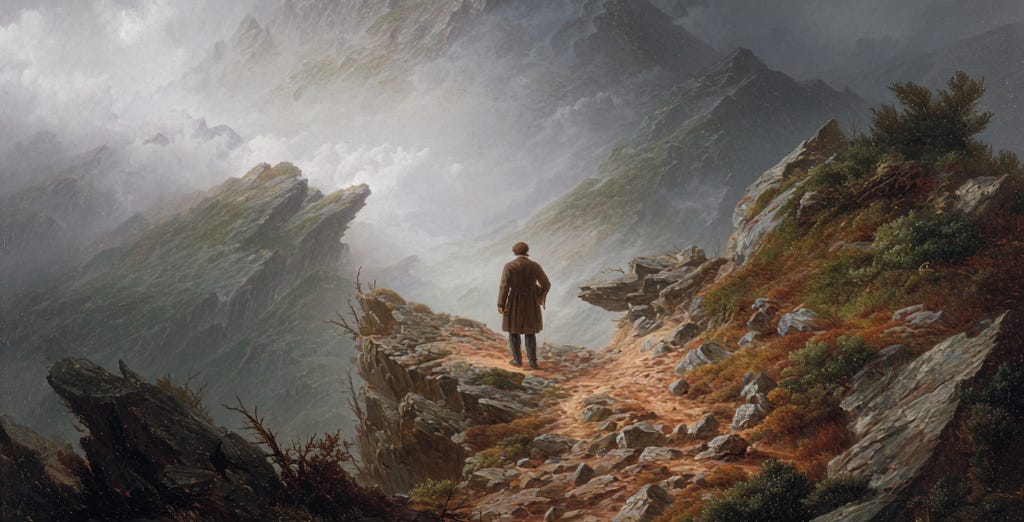
It helps me a great deal to meditate on the truths of God’s Word through metaphorical stories. I imagine and examine these stories for their veracity and, if helpful, hope to use them as a device with which to help others see their need for Christ. My hope is that this short allegory provides you with an instrument with which you can better understand the Gospel as well as, for the Christian, be reminded of the daily goodness of our God and King.
There are but two trails through life, and everyone must take one or the other. This is not a false dichotomy, but a truth borne out of human experience and history. Secular cultures and Christendom agree that the notions of right and wrong exist, in whatever perverse forms they do. Outside of the duality of right and wrong, there is no third option. Indeed they may present in spectrums between ends, but to be ambiguous or gray on morality is to deny the existence of morality in the first place, which is to say that for those who deny morality’s existence, anything is permissible. In light of this, I present an apt, though imperfect allegory of these two trails.
Let us begin with the first of these trails — the sinner’s road. It is one of comfort and ease, wherein there are many forks, loops, and byroads of vice and pleasure. Though the sinner is not at all equipped for a journey, he has no need for peripheral gear or preparation since his journey is over smooth and level track, lined with fruit in the hedgerows and lush, flowing streams of fancies, some of goodness and beauty, others of lust and vice. And it seems as though no matter which course he chooses, the path is clear and the direction is simply that which suits his impulses, for good or ill. He plucks and eats of succulent fruits and chases down all manner of paths. He does not care where he goes so long as the going is easy and the direction is of his own making. Whatever number of decisions and distractions there are along the way there are equal paths that shoot out into an infinite canopy of branches and self-oriented quests. No road is a wrong turn and he happily skips along, unaware of the final destination.
For the travelers on the sinner’s highway, they that realize their ignorance of the destination might begin to look beyond the pleasantries to gain answers to the question, “What is the point of this road and where does it lead?” The evidence around him whispers to him that if the journey is so full of beauty and enjoyment, then its end must have meaning and be of even greater significance. If he walks in garden paths, then the garden must have a curator and caretaker. If his journey had a start then it must arrive at some conclusion. After all, what is the point of a journey if not to go somewhere or do something? But he hasn’t a map or a guide or anything at all to determine where he is or where he is going. It is only when the sun goes down and he begins to fumble in the dark that he looks up to the stars for guidance — jewels of Truth beset into the fabric of God’s tapestry of conscience and morality.
He remains on well-trodden tracks, all of which eventually converge at the raging, black river of Death, at which he is dismayed to discover that he must either somehow cross or be swallowed up in it. Time does not grant him respite or a return to previous routes. Whether his decisions up unto this point have been for good or evil matters not. Whether he has prepared his heart and mind matters not. Whether he has left an inheritance and prepared his estate matters not. Whether he acted properly or poorly, it matters not. He must cross or be drowned. Only he hasn’t a bridge, nor a rope, nor companions to aid him in fording such a great, inevitable river. And so he lunges out, desperately flailing in the raging torrent that sweeps him into the frothing pool of eternity. With nothing to grasp or cling to, at once he realizes that all his journey and indulgences were for naught. That no matter his path, they all conclude in the same dreadful end. He cries out in vain panic to be saved, but it is too late. There is no one to hear him, no one to snatch him from the foam, and no hope or future lay before him. He is crushed under the weight of wave and water, forgotten and wasted — his path finished and the destination final.
But what can a man do? Is there any hope for him to escape such a pointless road that leads to disastrous ruin? For those on their way to destruction, some may lift up their eyes to the heavens and cry out, “God if you are there, I am aimless and lost! Though my journey is for myself, my sin leads me to Death and even my good deeds amount to nothing in the end! There must be another route, some goal in mind for all my traveling!” And upon hearing, the Lord will, for such a wanderer, provide a Signpost, a Word, a Preacher at a crossroad. As the Scripture says “How beautiful the feet of those who carry the Good News”! Upon hearing this Gospel, the sinner makes his choice — to continue toward his demise or to repent, believe, and be placed upon a new trail, in a new direction.
Now it seems to me that when a person believes upon Christ, he is immediately plucked from his current path and placed upon a new Trailhead; one that is rocky and steep. Like on his old path, he discovers that it branches and forks this way and that. Though now, it loops and winds over rough terrain and perilous crevasses. The hedgerows provide only brambles and the streams are but dry riverbeds of dust and debris. At once it appears that his faith has worsened his condition. “I imagined the road to heaven would be smoother”, he thinks. His first steps along this deteriorating trail are feeble. His feet are tender and his legs lack stamina or tone. Moreover, he discovers the road is fraught with traps and enemies not at all present on his former highway. Storms begin to brew, then batter him as he trods the thorny path in near darkness. “I never imagined it would be so,” he sighs, resolved to his fate.
No sooner has he realized his insurmountable weakness that with each new step, his steps begin to be established, his legs are strengthened. He is given a Lamp to light his way. He is clad in Armor to protect him from roadside foes. A sharp double-edged Sword is placed in his hand for defense and assault. His thirst is ever quenched with Living Water and his stomach is filled with a Bread that is infinitely satisfying. The Lord has provided everything he needs on his journey. “Though the way is perilous, all I hath needed the Lord hath provided”, he sings. His joy is full and his destination is known, though the way is yet shrouded in mist. Suddenly he is overwhelmed by the weight of grace and favor that has befallen him — that his Way is now one of purpose, accompanied by the sweet aromas of an eternity feast just across the river. The same stars that he once looked to for guidance, now placed within his eyes to illuminate the way before him, aiding in his navigation.
The trails wind and fork, and at each station he holds up his Lamp through the rain to decide the path. It matters not wither he go here or there or even that he ultimately decide rightly at each crossroad, only that the Lord indulges him with his presence and guide him by the map of His Spirit. God promises to be with him always until the end of the journey and evermore thereafter. Why then should he fear the storm, the foe, the rocks, the famine or drought? The Lord has now perfectly equipped the Christian for the dangerous paths. And it matters not which paths he chooses. For they, in their splendid array of branches and possibilities, all end at the same black river named Death. Like the sinner, whether he has decided properly or poorly matters not. Whether he has prepared his emotions and mind matters not. Whether he has left an inheritance and prepared his estate matters not. Whether he tread his path in perfect virtue, it matters not. He must cross or be drowned. What hope does he now have? There is but one thing that matters for his crossing, that is — Who owns the path he has trod? Who plucked him from his old way? Who is his life indebted to forever? Dear friend, at the black river of Death, there is but one thing that matters, and that is faith in Jesus Christ for salvation.
For the Christian, he needn’t be bothered with ropes, nor swimming, nor the help of earthly companions. No, his Way is secured only by means of a solid, yet narrow bridge called the cross of Christ, laid down across the chasm of Death by the death and resurrection of Christ himself. By it the Christian crosses in the footsteps of Christ without fear or harm. For he died long ago with Christ at the moment of his plucking and in all his missteps and stumblings on the trail of life ‘twas firstly Christ who trod the narrow way and ‘twas Christ who brought him through it. And now, he is able to cross into an eternity of fellowship with the author, provider, sustainer, and finisher of those who are on this trail. God has freely given us all things, provided all things, made a way for us, promised to never leave us or forsake us, being an ever present help in time of trouble, a companion, a refuge, a trailside cleft for our souls in the storms of life. Oh! That you still cannot see that it has all been done for thee! Help us see, Lord, that you are our portion, provider, and prize!
A sinner, though his way in this life may seem to be his own and it be of relative ease and pleasure, in the end will be left with nothing, even such that his very life and soul will be required of him. He is therefore infinitely bereft of God’s presence — something that no living being has ever yet endured. And what of the Christian? Though Christ promised him hardship, persecution, and death itself, he will, at the end of all things, be granted safe passage to the far shores of paradise by Way of the cross. Moreover he will be awarded the only and greatest things that can be given across the river, that is, the presence of God Himself, other people, and the bestowing of heavenly crowns. And what gift can a man give to God, who already owns all of heaven and earth? It seems to me that the only suitable gift we can muster for Him will be our own presence and the heavenly crowns that are given to us. Christian, may we cast our company and crowns at His feet in worship and adoration, for He alone is worthy to be praised. O sinner, will you not join Him in his halls? How long He waits for your gaze to turn heavenward and your voice to cry out, “Have mercy on me O Lord, a sinner! You alone are my hope.”
Sinner, repent and believe.